
China bans security software from the US and Israel

Bullets:
The founders and top executives of leading cybersecurity software companies have strong ties to the Israeli intelligence services.
In addition to contracts with the largest global companies, these companies' clients include US government agencies, the Pentagon, NATO militaries, and foreign defense contractors.
Effective immediately, cybersecurity software from Palo Alto Networks, Fortinet, CheckPoint, CyberArk, and a handful of other US- and Israel-based companies are banned in China.
China's central government has ordered all companies and institutions to identify and replace software products and systems from those firms by the end of June.
Report:
Good morning.
China now requires companies and government agencies to remove cybersecurity software systems from US and Israeli firms. Products from Palo Alto Networks, Fortinet, CheckPoint and a handful of others were specifically designated by the Chinese government to be removed. Organizations in Mainland China must immediately identify which products from these companies are used in their platforms, and replace them in the first six months of this year.
The concern is that their data are being sent out, via programs from American and Israeli software companies in the cybersecurity industry, who have deep ties to intelligence agencies. Bloomberg saw the original source document from China’s cybersecurity regulators, which said that products from Palo Alto Networks have security problems.
Other companies on the list are: Crowdstrike; Mandiant, a Google company; and Wiz; over a dozen firms in total from the United States and Israel. VMware is owned by Broadcom, and CyberArk is Israeli and has just been purchased by Palo Alto Networks. Cyber Ark has thousands of customers across the world, including many US and allied government agencies. They have contracts with the Department of Homeland Security, the Department of Defense, and the US Army.
Imperva is owned by a French company, Thales, whichhas big contracts with the US Army, the UK Navy, and for Rafale in India.
Some of these companies have significant operations here in China. Check Point is headquartered out of Tel Aviv, and has offices here on the Mainland. Broadcom’s got six offices, and Palo Alto has five.
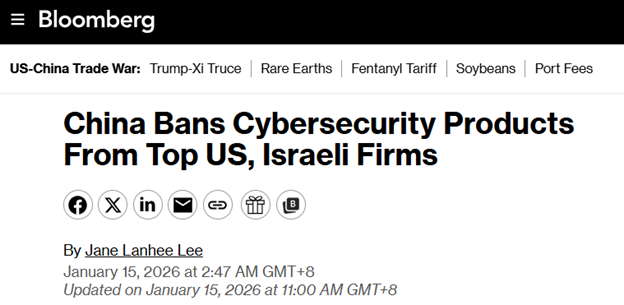
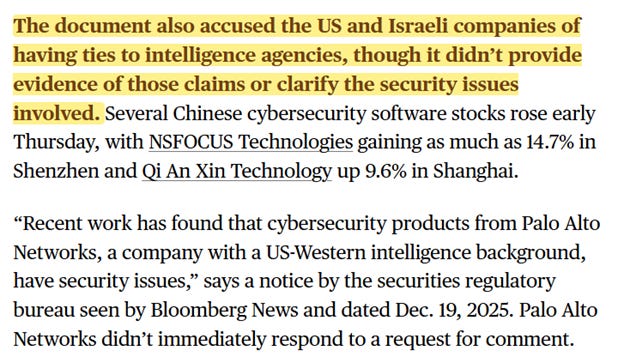
In their piece, Bloomberg reviewed the document for this directive, which “accused the US and Israeli companies of having ties to intel agencies, though it did not provide evidence of those claims.”
This is from Cyber Ark’s website, and the Founder and Chairman came from Military Intelligence.
This is from Palo Alto Networks, an even bigger company, with more than 70,000 clients in 150 countries, 85 of the Fortune 100. And the founder of Palo Alto Networks is another former veteran of the Israeli Intelligence Corps. He was head of software development in Unit 8200, an Israeli SIGINT and covert operations division.
This one is Check Point. Their new CEO established the Cyber Command in the IDF, and commanded Unit 8200:
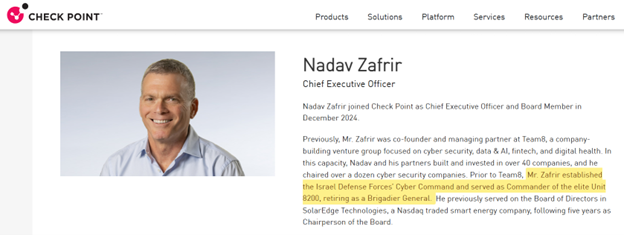
We didn’t have to dig too deeply here—the companies advertise their founders’ ties to military intelligence as a marketing tool, on their own websites. All I did was spend ten minutes on Google, and another five cutting and pasting, and Bloomberg could have done that too, instead of implying that these strong ties between the cybersecurity companies and Israeli intelligence is something running wild in the Chinese imagination.
So the concern here, from Beijing’s point of view, is that it’s hard to say who the people at these companies are really working for. If a Chinese company is running cybersecurity data software from a company based in Israel or California, and with strong ties to the Pentagon and the IDF, then it’s natural to wonder how secure their data really are.
The Chinese then are doing a “Delete-Israel” in its enterprise software and security systems. Earlier we showed that “Delete-America” is a national strategy to remove American and other Western technology from China’s most critical industries. Delete America is an initiative to ensure that China is self-sufficient up and down its supply chains.
China’s state-owned enterprises and business partners across the world are instructed to buy Chinese-built equipment for agriculture and construction, for example. And that’s bad news for John Deere and Caterpillar in any markets Chinese companies are heavily active. “Delete-America” also has had obvious implications for computer companies and semiconductors, and domestic suppliers in those industries have boomed as Western hardware gets replaced.
Here they’re doing the same thing, bur with software. Security software from Israel and the United States will be gone by June of this year.
Be Good.
Resources and links:
Exclusive: Beijing tells Chinese firms to stop using US and Israeli cybersecurity software, sources say
https://www.reuters.com/world/china/beijing-tells-chinese-firms-stop-using-us-israeli-cybersecurity-software-sources-2026-01-14/
Bloomberg, China Bans Cybersecurity Products From Top US, Israeli Firms
https://www.bloomberg.com/news/articles/2026-01-14/china-bans-cyber-products-from-top-us-israeli-security-firms
https://www.thalesgroup.com/en/worldwide/france
Thales wins £1.8 Billion contract to ‘maximise the days-at-sea for the Royal Navy
https://www.thalesgroup.com/en/news-centre/press-releases/thales-wins-ps18-billion-contract-maximise-days-sea-royal-navy
Thales awards SFO Technologies RBE2 radar wired structures contract for Rafale under Make in India
https://www.thalesgroup.com/en/news-centre/press-releases/thales-awards-sfo-technologies-rbe2-radar-wired-structures-contract#
CyberArk Government Procurement Contracts
https://www.carahsoft.com/cyberark/contracts
https://www.cyberark.com/company/leadership/
https://www.checkpoint.com/about-us/leadership/
Well done China ~ hopefully ditto to follow on other 'western-empire' big-tech software, also hopefully other BRICS+ countries to follow too!
China is helping the USA in its decoupling efforts.