
Gold disappears from Western vaults as India, China haul it away
India and China push gold prices to record highs, and pull from Western custodians following sanctions on Russia

Good morning.
Global gold markets are hitting all-time highs, and the internals of the gold price moves are confusing to industry insiders, in Western financial centers at least. Gold prices are moving higher, and faster, than economic fundamentals seem to suggest. What’s also interesting is that the gold prices aren’t simply moving—the gold itself is. China and India, most notably, are moving their gold reserves from Western banks to vaults here in Asia.
Bloomberg reports on a giant new vault in Singapore, called the Reserve. This Singapore group just built a six-story tall facility that can hold 500 tons of gold, which is half of the total trading volume of gold last year by central banks. They’ve also got big vaults for silver. They’re already doing lots of business, the feedback from customers is that they need new vaults in Singapore.
Gold is hitting record highs, and silver is up 20% on the year, and the buying in the OTC –the over the counter market-- is one of the highest in at least 25 years.
OTC is where sovereign wealth funds, institutional investors, and high-net worth investors get physical gold, and trading volumes there hit a record high last year—450 tons, and this year will be even higher.
This story is actually much more complex than it first seems, and it’s perplexing even to people in the gold markets every day. Here’s Bloomberg again and I like the way the piece is written, because we can tell that the Bloomberg columnists realize that the gold experts can’t explain what’s happening in their own markets. They’re asking, why is gold rising right now, whereas it was NOT rising previously, when the inflation rate and money printing were at much higher levels? Bloomberg got different answers, depending on whom they asked—central banks worried about the weaponization of the dollar, investment funds betting on a big interest rate cut that would spur more inflation, algorithms –these would be market momentum algorithms, I guess, weakening currencies, elections?
So they got looking, and concluded that although they have better access to trading data than ever before, still nobody knows what’s going on.
The “easy answer” is that central banks and traders are looking for a cut in interest rates, but that makes no sense at all, given heavy OTC buying from China and India: if HNW and institutional investors think an interest rate cut is coming, they would be buying Treasuring bonds, which would gain in value following interest rate reductions. In RMB and Rupee terms, the gains would be even greater. So the “easy answer” doesn’t make sense at all, and the Bloomberg editors know it.
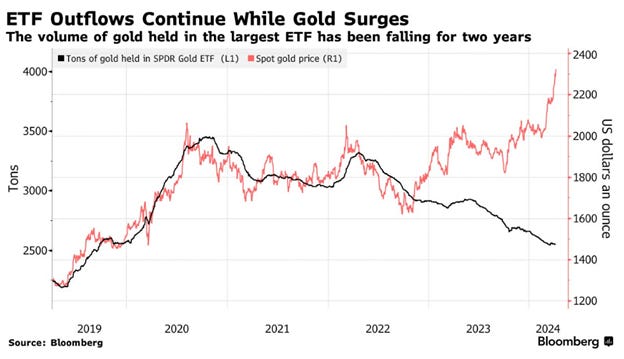
Here's another problem. The gold investors in this bull market are not buying gold ETF’s, which is the easiest way to invest in gold. Investors are buying the physical. Gold ETF’s are seeing outflows, in fact—investors are liquidating their positions in the ETF’s and buying the real thing. According to the President of the ETF store, it’s one of the most bizarre things he’s ever seen. Gold demand is strong from central banks and direct buys, but not in ETF’s.
Here's where the buying is: futures and OTC markets—major institutional buyers, like central banks, pensions, sovereign funds, investment banks. The options markets are betting that gold will go higher still. These are major investors who have not bought a lot of gold before, who suddenly are. And they’re not buying funds who buy and hold gold, they’re buying the gold itself.
Another strange feature, this time, is the timing of the gold buys, and the gold moves seem to ignore the economic data that suggest gold prices should be going down, not up. Institutional investors would typically look at the underlying economic data and scoop up bonds, which are guaranteed to go up if the Fed cuts interest rates. But they’re not buying bonds, they’re buying gold. The dollar is even going up, so buyers in China and India are paying still higher prices for the gold.
Analysts wonder if investors are betting on a hard landing, which might explain the ratio of the gold price to the federal funds rate. That might explain somewhat, the motivations for a US institutional buyer, but certainly not one from China or India. And that is where the demand is.
The real story: China and India central banks are driving the buying, and are doing so to de-risk from Western financial systems
The answer is actually pretty simple. China and the BRICS countries earn billions of dollars every day in trading surpluses, and have no place to put them. They’re not buying US treasury bonds anymore, they’re not leaving their funds in the Western banking systems. They’re moving assets out. And these gold buys are enormous, historically, but they represent only a small percentage of how much China, for example, actually earns in their current accounts, from trading surpluses. So they’re taking the funds and sweeping them to banks in Hong Kong or Singapore, to get them as far as possible as fast as possible outside Western regulators. And they’re taking some of their money and buying gold in our markets, but not through ETF’s.
And they’re also taking the gold itself, taking that out of the Western vaults and putting it into theirs. In 2022 China got 524 tons of physical from Switzerland, highest in years. India made news last month when they brought back 100 tons of gold from vaults in the UK, which followed a previous shipment of 102 tons back in May. “The Royal Bank of India is similar to other central banks, moving gold home to reduce the risks of storing wealth in foreign territories.” It’s expensive to move gold, lots of security and secrecy involved, it’s heavy, and so not only are the BRICS countries buying gold at record prices, they’re paying for it to be put on a plane or a ship and brought halfway around the world because they don’t trust our own governments or banks to hold it for them, and not take it.
Here’s why they worry about that. This is a timeline of India’s and China’s gold reserves by percentage increase. India was a net buyer anyway over the past 4 years.
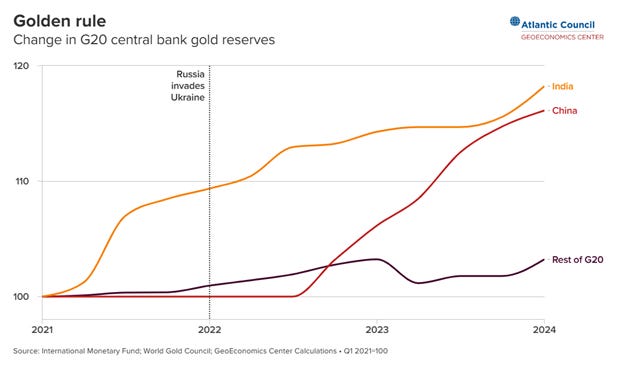
Invasion of Ukraine is early 2022, then later in the year when we put the sanctions on Russia, freezing their assets in American and European banks, Chinese gold buying went hyperbolic. They sold off US Treasury bonds, moved funds from Western banks to their own, and took some of it and bought gold—physical gold. Back to India, though—the recent, increased gold buying “suggests a strategic shift in geopolitics.” A chief economist in India says “the US dollar is historically stable, but its reliability is diminished.” The West’s response to Russia’s invasion made them realize that their assets held in foreign custody could be blocked or immobilized by other governments or banks. That includes bonds lent to Western governments, that includes reserves sitting in Western banks, and that includes gold sitting in Western vaults.
Everyone knows the problems of owning gold. It costs money to store it and protect it. It’s not income-producing. But it’s got no counterparty risk. The gold buying by China and India is de-risking. And here’s the ETF problem, for them: in an ETF, the transactions are recorded.
Investors have been largely shunning exchange-traded funds, which are one of the easiest ways to invest in precious metals, with holdings from these investment vehicles dropping nearly 900 tons of gold since a peak in 2020, while silver ETFs have shed about 9,500 tons since 2021. The lack of anonymity is a disadvantage to owning an ETF because transactions are recorded, Panigirtzoglou said. A paper certificate via an ETF is subject to counter-party risk — that “looks less attractive and less safe than tangible gold stored privately,” he said.
If you’re worried that a foreign government is going to seize the gold in a vault, buying ETF’s is no answer because they can just freeze that too. Every other alternative—last line there—gold on paper, gold in a foreign vault—is less attractive and less safe than tangible gold, stored privately. That’s why that Singapore company just built a giant vault. That’s why India in May called their custodians in the UK and telling them they’re coming over later with some trucks and planes to take a hundred tons home, then they called up and did it again four months later. It’s because across the world, our credibility is gone, and so is the gold.
Resources and links:
Bloomberg, As the Rich Snap Up Gold Bars, Storage Vaults Brace for Business https://www.bloomberg.com/news/articles/2024-08-20/as-the-rich-snap-up-gold-bars-storage-vaults-brace-for-business
Bloomberg, The Gold Market Hunts for Answers Behind Bullion’s Sudden Surge https://www.bloomberg.com/news/articles/2024-04-07/the-gold-market-hunts-for-answers-behind-bullion-s-sudden-surge
Reuters, Switzerland sent 524 tonnes of gold to China last year, the most since 2018 https://www.reuters.com/markets/commodities/switzerland-sent-524-tonnes-gold-china-last-year-most-since-2018-2023-01-24/
India outpaces the rest of the G20 in gold purchases https://www.atlanticcouncil.org/blogs/econographics/india-outpaces-the-rest-of-the-g20-in-gold-purchases/
Times of India, India has brought back 1 lakh kg of gold from UK https://timesofindia.indiatimes.com/etimes/trending/india-has-brought-back-1-lakh-kg-of-gold-from-uk-and-why-its-a-good-news/articleshow/114504808.cms
RBI Transfers 102 Tonnes of Gold from UK to India Amid Global Unrest https://spoindia.org/rbi-transfers-102-tonnes-of-gold-from-uk-to-india-amid-global-unrest/